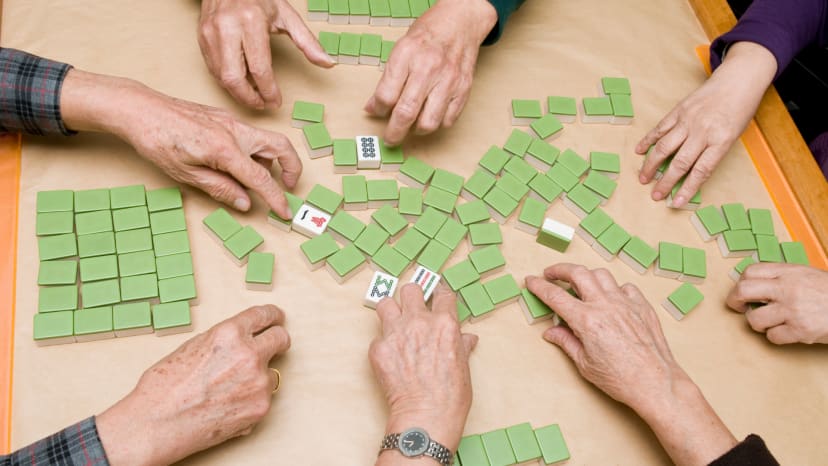
Mahjong isn't a difficult game, but the sheer volume of information to remember can be a bit overwhelming at times. This is why some players aren't always clear on how to score in mahjong. However, there are just a few key things to keep in mind if you want to master a specific variation.
If you're looking for a clear explanation of how to score in mahjong, you've landed in the right spot. This guide will break down everything you need to know about mahjong scoring. Let's dive in!
Understanding Mahjong Scoring Criteria
The criteria for scoring can include specific mahjong tile melds or other hand formations, the way the hand was played, and the presence of unique combination sets. When multiple criteria are met, and some are subsets of others (like having a meld of one dragon versus a meld of all three dragons), only the criteria with the stricter requirements will be scored.
The points accumulated can be converted into individual player scores using a scoring system. These scores are typically used to determine payments between players while playing mahjong as a form of friendly gambling or betting.
It's important to note that 'points' and 'score' can refer to different concepts. Players often exchange money based on the points they've earned throughout a round, alongside other considerations. In some variations, chips or other tokens might be used instead of direct monetary exchange during play.
In many scenarios, only the winner receives a payout, with the scores of the three losing players being adjusted by the winner's gain. However, there are various established methods for settling payments between participants. These commonly include:
- If a player wins by claiming a discard, the player who made that discard pays double the amount.
- If a player wins by a tie (a drawn hand), every losing player must pay double.
- In the event that a player wins from a high-risk situation (e.g., a self-drawn winning hand), the player who made the last discard pays for the other two losing players.
Mahjong Scoring Rules for UK Players
Chinese Mahjong Scoring Explained
The rules for scoring in mahjong, particularly the Chinese variation, are as follows:
- Based on the presence of specific melds, pairings, and bonus tiles, each player adds up the fundamental points for his hand.
- Each player doubles his basic points one or more times based on ownership of specific uncommon melds or combinations of melds. The winner adds additional basic points for gaining mahjong and maybe for finishing his hand in several unique ways.
- Depending on his hand's formation of uncommon patterns, such as those made completely of honour tiles, or being finished uniquely, such as stealing an exposed kong, the winner doubles his basic points once or more.
- Each of the three losers pays the winner his entire points.
- The losers split the difference into points among themselves.
- In his dealings, East makes duplicate payments or receipts.
- There are many Special Limit hands that, if acquired, provide the possessor with the most points assigned to his hand.
American Scoring
In the American version, players utilise a card with a point value for each hand that specifies a narrow number of hands as the only legitimate winning hands. Two main Mahjong regulatory organisations in the United States, the National Mahjong League and the American Mahjong Association, employ this method, with new cards that specify the legal winning hands being produced every year. Each card often includes scoring requirements that make mention the year the scorecards are published.
Shanghai Scoring
The Shanghai variant's scoring system is complex, with a wide range of requirements and exaggerated ratings for more uncommon hands like the thirteen terminals. There is typically a minimum point value in the Shanghai variation due to the inflated point values.
Singaporean Scoring
While using a different set of tiles, Singaporean scoring is comparable to the Chinese scoring method. Here, regular payment variations apply. But, there are those in which the dealer is also required to pay and receive twice.
Hong Kong Scoring
Due to the limited number of factors used in the traditional Hong Kong scoring method, the score is often quite low. The point translation function is a piecewise function, and general scoring modifiers are in play.
Hands with no points are awarded a set amount, and each point doubles the score. Players sometimes play with the added rule that a winning hand must have a certain point value, often between one and five points, with three being the most common. This is because zero-point hands are frequent.
Japanese Scoring
Each player begins with a score, typically between 25,000 and 30,000 points. This can be an agreed-upon starting value. In modern tile sets, this is often represented by a row of bars with denominations of 10,000, 5,000, 1,000, and 100. These bars resemble long Chinese dominoes. Online, you'll usually just see the point totals.
Understanding Limits in Mahjong Scoring for UK Players
Some Mahjong variations impose a score limit. In many situations with these limitations, the usual point translation function applies, assigning a constant score for points up to the first limit. Once further limits are reached, the score increases.
A scoring limit can act as a gambling incentive. For instance, if the scoring limits were six and nine points, a hand with seven or eight points would be valued the same as a six-point hand. This might encourage players to aim for nine-point hands.
High-Risk Discards in Mahjong
As the wall size decreases, some versions may also impose penalties for discards deemed high-risk. If a player wins or goes out by self-drawing after making a high-risk discard, they are responsible for covering the winner's points. A discard is considered dangerous if there are enough open melds to suggest that, before it was claimed, it would have very likely led to the completion of a limited hand.
Conclusion: Mastering Your Mahjong Choice
Some complications arise when players try to play different mahjong variations at once. So, it’s best to stick with one variety and master it first.
In this guide, we've discussed different rules for various Mahjong variations so that players can choose their preferred game. We've covered Chinese, American, Japanese, Shanghai, Singaporean, and Hong Kong Scoring. We hope this information provides a solid foundation for an enjoyable gaming experience for UK players.
FAQ
What's the highest possible score in Mahjong?
Even though a player's tiles' value can significantly increase when doubling the calculation, the maximum score in Mahjong is generally considered to be 1,000 points.
How does scoring work in Chinese Mahjong?
Each hand is assigned a score ranging from 1 to 88 points, based on its difficulty. These points are then added together for a straightforward total. In the official Chinese version, a minimum of 8 points is required to declare Mahjong.
How is Western Mahjong scored?
- A hand containing 4 Pungs scores 6 points.
- A hand containing 4 Chows scores 2 points.
- 2 points are awarded for 1 Dragon Pung or Kong.
- Six points are awarded for a pair of Dragon Pungs.
- A Pung/Kong of Winds that corresponds to the seat or round earns 2 points.
- Seasons/Flowers tile: 1 point each.
- 1 point is awarded if the win is self-drawn.